The Art of Hospitality
Your bedroom is where you close your eyes for a third of your life, exposing your body to its immediate surroundings. Discover how our Clean Sleep standard eliminates the residual pesticides, formaldehydes, and heavy metal dyes found in conventional sheets to create a completely skin-safe resting space.

In the global luxury hospitality landscape, excellence was traditionally defined by visible opulence — grand marble lobbies, ornate architecture, and formal service scripts. But as the international luxury traveller matures, these external markers have lost their primary value. Today's sophisticated guest — whether checking into a boutique estate in Europe or a wellness retreat in Asia — seeks a different metric entirely: an authentic sense of sanctuary, material integrity, and deep physical wellbeing.
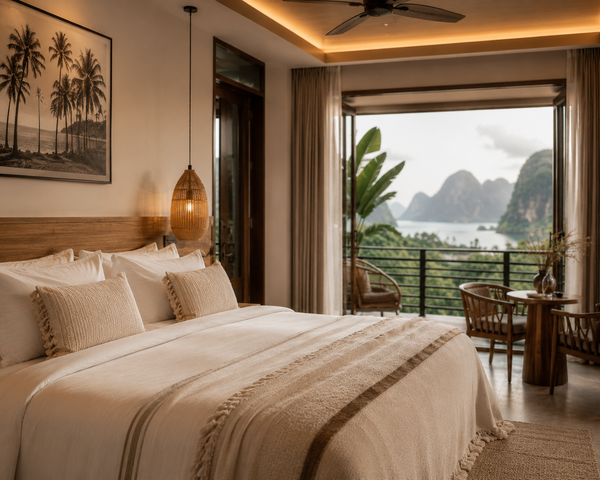
For general managers, procurement directors, and hotel owners, every interior choice is a direct extension of brand equity. Yet among the countless touchpoints across a property, none is more intimate or impactful than the guest bed. A traveller may spend an hour in your lounge or twenty minutes at your concierge desk — but they will spend upwards of eight uninterrupted hours wrapped in your bed linens.
This is the definitive moment of any guest stay. The quiet, private experience where the promise of luxury is either completely validated or instantly shattered. Transitioning to a GOTS-certified organic, long-staple linen supply chain is no longer just a marketing decision — it is a critical business strategy that directly impacts asset longevity, operational efficiency, and guest retention.
Unmasking the industrial finish
To withstand the punishing laundry environments of commercial hospitality, conventional corporate linens are heavily treated during manufacturing with synthetic resins, starches, and formaldehyde-based finishes. This creates a temporary, crisp smoothness designed to survive initial installation. Under the intense heat of commercial rotary irons and repeated chemical bleaching, these coatings strip away rapidly — exposing the rough, short-staple filler yarns underneath.
The guest pays the price. Depleted chemical fibres inhibit the cotton's natural ability to breathe, creating an insulated trap that seals in body heat and causes night sweats — the leading cause of sleep disruption reported by travellers. This is the same structural failure we describe for consumer bedding in why softness at first touch is almost always a synthetic illusion. In a hotel context, the consequences compound across thousands of wash cycles.
An organic, zero-chemical baseline solves this at the fibre level. Ultra-long staple cotton retains its natural protective waxes and structural elasticity. The fabric breathes perfectly and self-regulates. Instead of deteriorating, our long-staple single-ply linen matures with every commercial wash — becoming progressively softer, more fluid, and more luxurious over time. A guest registers this the second they slide under the covers.
The operational mathematics of longevity
In hospitality procurement, decisions must balance upfront capital expenditure against long-term operational costs. The persistent myth is that sustainable, organic textiles are too fragile for commercial operations. Evaluated at the fibre engineering level, the exact opposite is true.
| Operational performance metric | Conventional corporate textiles | Texaura organic single-ply |
|---|---|---|
| Yarn construction | Short-staple fibres twisted into multi-ply bundles to inflate thread count numbers | Ultra-long staple, single-ply pure cotton fibres left completely intact |
| Tensile strength | Chemical degradation causes fibres to snap, pill, and thin out rapidly under commercial washing | Long-chain fibres maintain inherent tensile elasticity through hundreds of harsh wash cycles |
| Replacement cycle | Becomes abrasive, scratchy, and yellowed within months — requiring high replacement volume | Gains a fluid, premium drape over time — vastly extending the operational lifecycle |
Because our linens are built from intact long-staple single-ply yarns, their structural integrity is significantly higher than conventional multi-ply alternatives. They resist pilling, maintain their natural white profile without degrading, and endure hundreds of commercial laundering cycles without losing their hand-feel. This directly lowers a property's replacement frequency and stabilises the long-term linen budget. The thread count arms race that drives consumer confusion — covered in detail in our essay on why thread count is a manufactured metric — is equally misleading in hospitality procurement.
Aligning the brand with global ESG realities
Modern international travellers can instantly identify corporate greenwashing. They notice when a luxury hotel places a card on the nightstand asking them to reuse towels to "save the planet," while simultaneously wrapping their bodies in chemically bleached, mass-production sheets. This disconnect erodes guest trust faster than almost any other operational failure.
Shifting your property to a verified organic, artisan-supported supply chain brings transparent, measurable data to your brand's sustainability narrative. Organic cultivation uses up to 91% less groundwater, relying on natural rainfall and organic soil management. Our manufacturing process bans heavy metals and toxic chemicals entirely — meaning the wastewater generated during your laundry cycles is significantly cleaner, easing the load on your property's water treatment infrastructure.
Partnering with Texaura gives a luxury property a cohesive, honest story. Knowing that their linen is crafted by multigenerational artisan communities in Jaipur gives guests a genuine sense of place and purpose — transforming an ordinary room night into a culturally grounded, conscious experience. It demonstrates that true hospitality is not cold, automated replication. It is a deep, authentic commitment to the human beings who sleep in your beds, and the planet that sustains the business built around them.
To explore a B2B supply partnership, visit our partner programme page, or read more about the global opportunity in sustainable bed and bath textiles.