The Architecture of Rest

The global definition of luxury has fundamentally shifted. For generations, high-end home design equated luxury with excess — ornate embellishments, heavy drapes, loud branding, and layers of purely decorative textiles that crowded a space. Success was measured by how much could be displayed.
Today, the modern home serves a completely different function. In a world of constant digital noise and aesthetic overstimulation, our living spaces have taken on a vital new role: they must act as a sensory sanctuary. True luxury is no longer about accumulation. It is about elimination — the intentional curation of space, the rejection of clutter, and the quiet sophistication of high-grade, sustainable materials.
In contemporary interior design, minimalism is not the absence of style. It is the presence of absolute clarity.
1. Visual peace: the psychology of the minimalist bedroom
Our surroundings have a measurable impact on our neurological state. A bedroom crowded with complex patterns, synthetic textures, and unnecessary visual clutter forces the brain to continuously process information — keeping the nervous system in a state of low-level alertness. Loud patterns and cluttered layers produce continuous sensory processing that makes genuine rest harder to reach.
A minimalist approach inverts this entirely. Clean architecture and pure neutrals produce immediate visual calm — and from that calm, deeper, more restorative sleep follows. This is the connection between physical environment and sleep quality we explore in why sleep wellness is the defining luxury of our time.
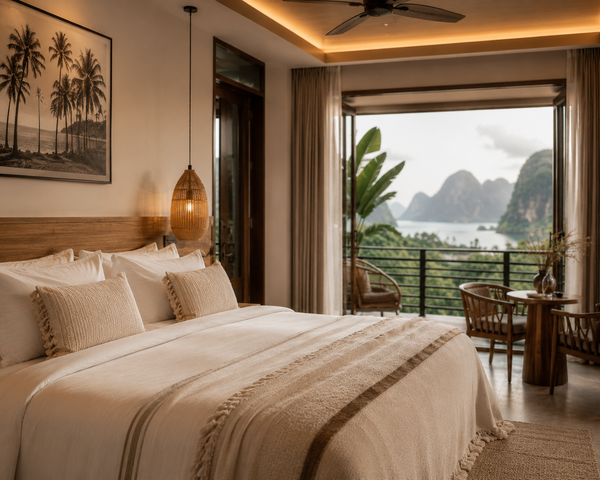
A streamlined bed dressed in a refined, neutral palette — crisp whites, muted stones, soft ivory, or deep graphite — allows the eyes to rest and the mind to disengage from the day. When you strip away the superficial layers, the focus shifts entirely to the geometry of the room, the natural flow of light, and the raw, unadulterated quality of the fabric itself.
2. Material integrity: where minimalism meets substance
When a brand can no longer hide behind busy patterns or heavy chemical finishes, the raw quality of the material is completely exposed. This is the beautiful vulnerability of minimalist home textiles: the fibre must be flawless.
Mass-market manufacturers use low-grade, short-staple conventional cotton coated in artificial silicone softeners to simulate premium quality in the box. It is a fragile illusion — one that degrades after a few washes and leaves behind a rough, pilled, non-breathable fabric. We cover this in full in the illusion of mass-market bedding.
True minimalism requires uncompromised material integrity. At Texaura, we craft our collections using only GOTS-certified organic cotton with premium extra-long-staple fibres. Left entirely pure and free from synthetic toxins, these yarns possess an inherent architectural weight and fluidity — offering a breathable, hypoallergenic microclimate that embraces your skin with genuine, long-lasting comfort. No chemical makeup required.
3. Mass-market excess vs. intentional curation
| Design attribute | The old luxury (mass-market excess) | The new luxury (Texaura minimalism) |
|---|---|---|
| Aesthetic philosophy | Loud patterns, chemical sheen, and heavy ornamentation | Architectural lines, pure textures, and organic neutrals |
| Material base | Short-staple conventional cotton with synthetic finishes | Long-staple, 100% GOTS-certified organic cotton |
| Longevity profile | Coatings wash out quickly; fibres pill and thin | Fabric blooms and grows softer with every wash |
| Spatial impact | Crowds the room; traps heat, dust, and visual clutter | Opens the space; promotes air circulation and mental clarity |
4. The sustainable core: fewer, better things
At the heart of modern minimalism is a commitment to conscious consumption. The fast-fashion home decor model encourages continuous replacement — cheap, synthetic throws and low-quality sheet sets that lose their form within a single season. The ecological cost of this cycle is substantial, and the personal cost is a home that never quite settles into itself.
Choosing a minimalist home means investing in pieces designed to endure. Premium long-staple organic yarns carry incredible tensile strength — producing decades of pure utility from a single, considered purchase. Because Texaura's organic percale and sateen weaves are crafted with native structural resilience, they do not deteriorate. They undergo the natural blooming phenomenon we describe across our full range: pure cotton fibres relax and open with every laundry cycle, becoming more fluid, supple, and uniquely yours over time.
By selecting a few impeccably made, timeless textile elements, you significantly reduce your ecological footprint while surrounding yourself with objects that hold lasting meaning. This is the philosophy at the centre of how Texaura began — and it remains the standard to which everything we make is held.
Reclaim your space
Luxury is not a loud proclamation. It is a quiet feeling of complete alignment. Elevating your home with a minimalist textile palette is a statement of intent — a declaration that your space is reserved for deep restoration, clean living, and authentic craftsmanship.
Step away from transient trends and synthetic clutter. Explore the organic cotton bedding collection, or browse the complete Texaura collection.